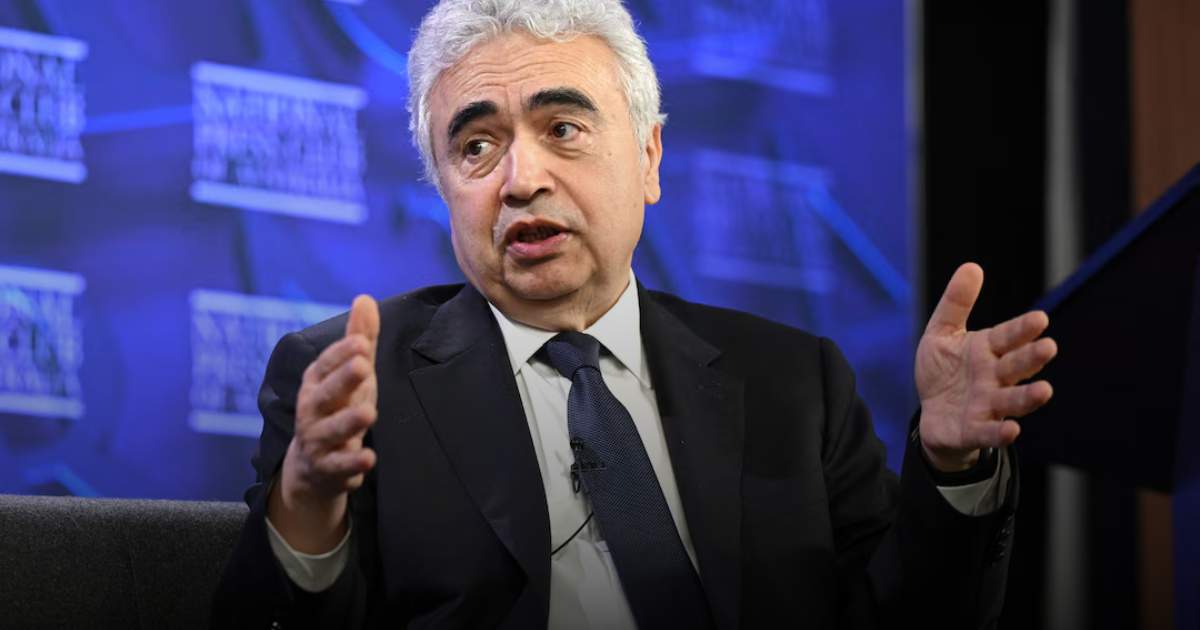
IEA chief Fatih Birol said Middle East energy output may take about two years to recover to pre-war levels.
The IEA says reopening the Strait of Hormuz remains the most important step for restoring supply.
IEA member countries released 400 million barrels from emergency reserves in March, the largest coordinated drawdown in the agency’s history.
The business impact reaches far beyond oil producers and could hit logistics, aviation, manufacturing, import-heavy economies, and SMEs.
Even with oil easing on April 17, Brent still closed near $97.55 a barrel, showing markets remain sensitive to any disruption in the region.
Middle East energy risk is now a business story
The latest warning from the International Energy Agency should matter to far more than commodity traders. Fatih Birol, the agency’s executive director, said on Friday that Middle East energy production could take around two years to return to pre-war levels, even if the Strait of Hormuz reopens. He also warned that markets may be underpricing the damage from a prolonged disruption.
For business readers, that shifts the story immediately. This is no longer only about oil output. It is about how a long recovery could feed into transport costs, import bills, industrial fuel supply, and corporate planning across the region.
Why the Strait of Hormuz still matters so much
The Strait of Hormuz remains one of the world’s most important energy chokepoints. The U.S. Energy Information Administration has said the waterway handled about 21 million barrels per day in 2022, equal to roughly 21% of global petroleum liquids consumption. That makes any disruption there a direct threat to shipping flows, refinery supply, and fuel availability well beyond the Gulf.
Birol said reserve releases can ease short-term bottlenecks, but they cannot replace the role of normal traffic through Hormuz. He added that production could improve significantly once the waterway reopens, yet full capacity would still take time because of wider infrastructure damage across the region.
“Markets may be underpricing the fallout from a prolonged closure of the Strait of Hormuz,” Birol said, according to Reuters’ account of his remarks.
What the IEA has already done
The IEA has already moved aggressively to reduce immediate pressure. On March 11, the agency said its 32 member countries had unanimously agreed to make 400 million barrels from emergency reserves available to the market, calling it the largest oil stock release in its history.
That matters because it shows policymakers are treating the disruption as more than a temporary price spike. At the same time, the IEA has made clear that stock releases are a bridge, not a cure. The real fix still depends on restoring normal regional supply flows.
What this means for businesses in the Middle East
For companies, the risks break down into a few immediate pressure points:
Transport and logistics costs could stay elevated if fuel markets remain tight.
Import bills could rise for economies and companies that rely heavily on external supply.
Industrial operations could face strain if diesel and other refined products tighten.
Aviation and tourism could suffer if jet fuel shortages trigger cancellations or route changes.
SMEs could feel the squeeze first because they have less room to absorb sudden cost shocks.
Birol said no new deliveries of oil, gas, or refined fuels had reached Asian markets as the disruption dragged on, and he warned that supply gaps were beginning to appear. He also flagged the risk of shortages in products such as kerosene and diesel if crude shipments fail to reach refineries.
That warning has direct business implications. Airlines, freight operators, factories, food importers, and distributors do not need a full physical shortage to suffer damage. A tighter market alone can raise working-capital needs, delay procurement decisions, and eat into margins. That is especially true in sectors where fuel and transport are already large cost items. This is an inference based on the supply and pricing pressures cited by the IEA, IMF, and Reuters reporting.
Oil prices have eased, but the risk has not disappeared
There is an important nuance here. Oil prices fell on April 17 on hopes of diplomatic progress, with Brent crude settling at $97.55 a barrel and WTI at $92.53. Yet Brent remained close to $100, and Reuters reported that ongoing constraints in Hormuz were still limiting how far prices could fall.
That means businesses should not mistake one down day in the oil market for a return to normal. Price relief driven by diplomacy can vanish quickly if shipping remains constrained or if physical damage across the region proves harder to repair than expected.
Why import-heavy economies look especially exposed
The IMF warned this week that Asia is particularly vulnerable to an energy shock because of its reliance on imported fuel from the Middle East. It also said the wider Middle East and North Africa region faces uneven fallout, with oil-importing economies exposed to commodity-price shocks and slower regional spillovers.
That point matters for the Eastern Mediterranean and Levant as well. Businesses in import-reliant markets tend to face the hit twice: once through higher energy and freight costs, and again through weaker domestic demand as inflation squeezes consumers. This is an inference drawn from the IMF’s warning on import dependence, inflation pressure, and uneven regional fallout.
The biggest takeaway for founders and executives
The key lesson is not that every company faces the same level of risk. It is that too many businesses may still be treating this as a headline for oil traders rather than a broader operating challenge. Birol’s warning suggests the disruption may last longer than many market participants had assumed.
For executives, that makes the story practical. It raises questions about fuel exposure, supplier concentration, shipping routes, inventory buffers, pricing flexibility, and cash flow resilience. The companies that respond early will likely cope better than those waiting for conditions to normalize on their own. That is a business judgment based on the verified duration and supply-risk signals in the IEA and IMF reporting.