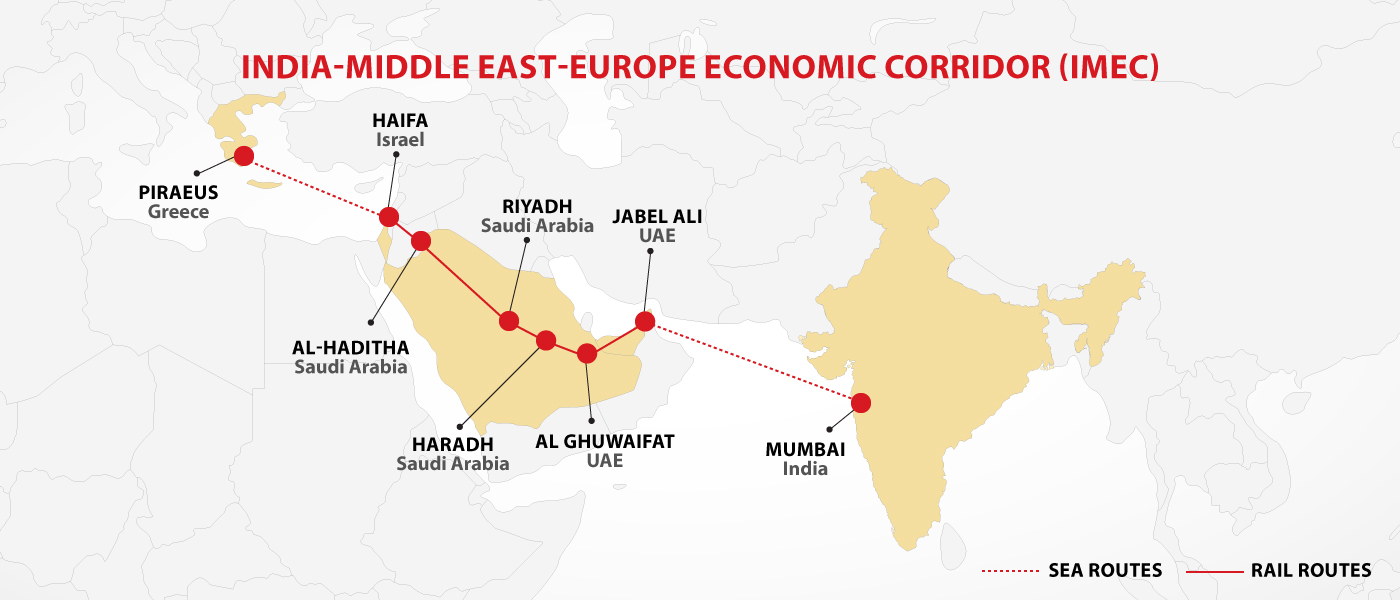
IMEC — the India–Middle East–Europe Economic Corridor — is a proposed trade and infrastructure corridor combining shipping + rail, with plans to lay digital connectivity cables, electricity links, and potentially clean hydrogen pipelines along the route. It was announced at the G20 in 2023 and signed as an MoU by India, the UAE, Saudi Arabia, the EU, France, Germany, Italy, and the U.S.
Lebanon is now actively exploring whether Beirut and Tripoli ports can connect to this corridor, with meetings held between Lebanese leaders and France’s IMEC envoy. But Lebanon is not yet a confirmed IMEC participant — it is at the feasibility and positioning stage.
1) What is IMEC, exactly?
IMEC is a proposed multi-modal connectivity project designed to link India to Europe via the Gulf by combining:
sea transport (shipping lanes and ports), and
rail infrastructure for cross-border cargo movement (ship-to-rail networks).
Crucially, the MoU text also states the corridor is intended to enable the laying of:
digital connectivity cables,
electricity cables, and
pipelines for clean hydrogen export “along the railway route.”
The idea is to create a faster, more resilient alternative or complement to existing trade routes, reduce bottlenecks, and strengthen supply chain security.
Who signed it?
The MoU was signed by India, Saudi Arabia, the UAE, the European Union, France, Germany, Italy, and the United States on the sidelines of the G20 Summit (Sept. 9, 2023).
Important legal note: the MoU is a political framework — it does not automatically create binding obligations under international law, per the document language.
2) Why is Lebanon talking about IMEC now?
In late February 2026, Lebanon’s leadership held a series of meetings with Gérard Mestrallet, the French President’s special envoy for IMEC, to discuss whether Lebanon can integrate its ports into the corridor’s planning and feasibility phase.
Prime Minister Nawaf Salam discussed the economic feasibility of integrating Beirut and Tripoli ports into IMEC, explicitly framing the issue as urgent due to shifts in regional trade routes and competition from neighboring ports.
President Joseph Aoun separately said Lebanon is “ready to engage” within the corridor framework in a way that serves national interests and strengthens its logistics role.
And the French envoy visited the Port of Beirut, where port leadership presented rehabilitation steps and a vision for Beirut to become a “strategic hub” on the corridor route.
3) The business case: what Lebanon could realistically gain
For Lebanon, the upside is not automatic “billions.” The realistic opportunity is repositioning: becoming a Mediterranean logistics node that captures economic activity from flows moving between the Gulf and Europe.
If Lebanon were integrated into corridor-linked networks, potential gains could include:
A) Port throughput + logistics services
More container traffic and transshipment activity
Higher demand for warehousing, trucking, cold chain, and freight-forwarding
Growth in customs brokerage and compliance services
B) Services exports
Port-linked corridors tend to pull in:
finance and insurance services
legal and trade compliance services
tech services (tracking, logistics SaaS, security)
C) Investment signal
Even “being on the map” can matter: it can influence how investors assess Lebanon’s ability to reconnect into regional trade systems — especially if paired with credible reforms.
But every one of those benefits is conditional on execution.
4) What it would take for Beirut and Tripoli to actually plug in
IMEC is built on “reliability.” Lebanon will have to make itself legible to partners and shippers. That comes down to four requirements:
1) Infrastructure readiness (hard capacity)
Port equipment, berths, storage capacity, and modern handling systems
Predictable operating hours and performance standards
The Port of Beirut has presented phased rehabilitation efforts aimed at improving readiness and supply chain efficiency.
2) Governance + procurement (soft capacity)
Regional corridors rely on:
transparent contracting,
predictable rules,
stable operating frameworks.
Without that, shippers and partners price in risk and choose alternatives.
3) Border procedures and digitization
Any corridor relies on speed through customs. That means:
single-window processes,
clear compliance,
digital documentation pathways.
4) Security and geopolitical risk pricing
Lebanon’s corridor pitch is happening amid heightened regional volatility. Any escalation increases insurance costs, rerouting risk, and supply chain hesitation.
5) The political constraint: IMEC’s Israel-linked geography
The IMEC MoU explicitly mentions transit “between India, the UAE, Saudi Arabia, Jordan, Israel, and Europe.”
That creates domestic sensitivity in Lebanon, where normalization is politically and legally fraught. Local reporting notes that Lebanon’s IMEC discussions have sparked debate about the risk of indirect normalization due to Israel’s role in the corridor concept.
For LeBusiness readers, the takeaway is practical: any Lebanon integration concept would need a clear, lawful framework that aligns with Lebanese policy positions while still meeting corridor partners’ logistics requirements.
6) What to watch next
If Lebanon is serious about turning IMEC from “headline” to “economic project,” three near-term signals matter most:
Feasibility outputs: published or disclosed technical assessments for Beirut and Tripoli integration.
Port modernization milestones: credible progress metrics at Port of Beirut and Tripoli.
Partner clarity: whether corridor partners signal a pathway for Lebanon’s inclusion, and under what operating and governance conditions.
Bottom line: IMEC is a regional trade map shift. Lebanon is trying to get back on that map — but success will depend on execution, not geography alone.