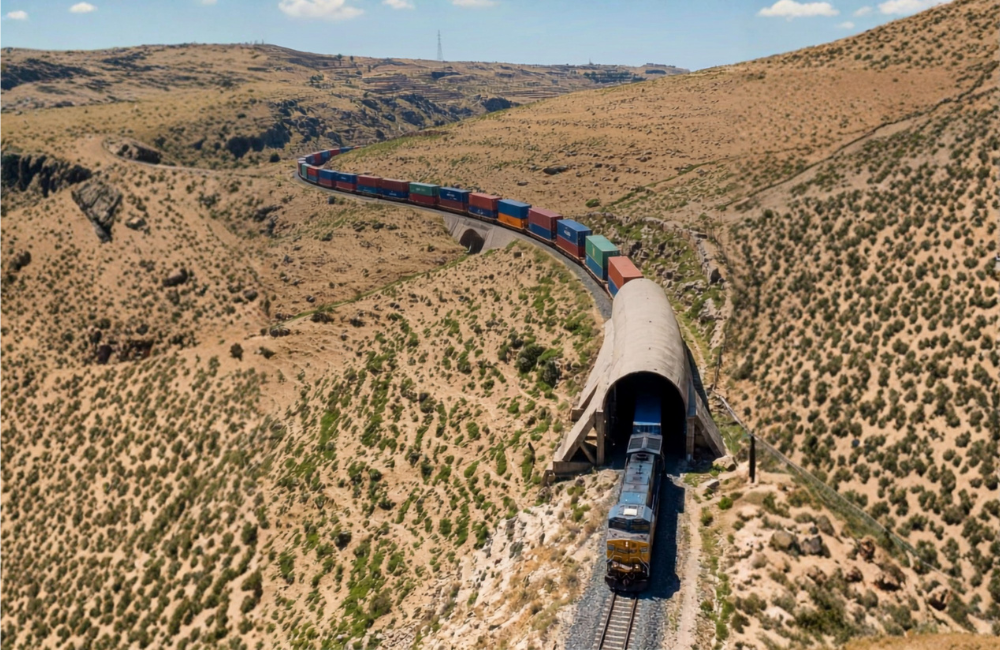
What Lebanon Just Launched
Lebanon has started a feasibility study for a railway that would connect the Port of Beirut to the Masnaa crossing on the Lebanese-Syrian border, running through the Bekaa Valley. The line is designed mainly to move freight rather than passengers. Officials have left the door open to extending the route into Syria at a later stage. A feasibility study is the first formal step, where engineers and economists test whether the project can actually be built and paid for.
The study is being driven by Lebanon's Council for Development and Reconstruction together with the Beirut port authority, which have signed cooperation agreements to begin the technical and financial work, according to reported details of the plan. The proposed line would follow a route from Beirut through Dar Chmoun, Qortada, and Aaraya before reaching Sawfar and continuing east toward Masnaa.
The Dry Port in the Bekaa
The railway is only one half of the plan. The second piece is a dry port in the Bekaa Valley, an inland cargo terminal that would act as an extension of the Port of Beirut. A dry port works like a seaport that sits away from the coast. Goods arrive there by rail, then get stored, cleared through customs, and sent on to their final destination.
Placing this terminal in the Bekaa would bring port services closer to one of Lebanon's main agricultural and industrial regions. Farmers and manufacturers in the area currently depend on a long road trip to and from the coast for anything they import or export. An inland terminal connected by rail would shorten that gap and let cargo clear customs without clogging the capital.
Why the Plan Targets Trucks First
Today, most cargo that lands at the Port of Beirut and heads to the Bekaa travels by truck. That keeps thousands of heavy vehicles on the mountain roads between Beirut and the valley, which adds wear to the infrastructure, raises fuel and logistics bills, and slows down traffic for everyone else. Moving freight onto a railway can carry far more weight per trip at a lower cost per ton.
Supporters of the project argue that a working rail corridor would lower transport costs, reduce road congestion, and make the movement of goods more predictable. Beyond logistics, they say the construction and operation of the line could create jobs and bring economic activity back to towns along the route. The same backers frame the corridor as a way to restore Lebanon's older role as a trade gateway between the Mediterranean coast and inland markets.
The Bigger Trade Map: A Possible IMEC Link
The most ambitious part of the vision is a possible tie-in with the India-Middle East-Europe Economic Corridor, known as IMEC, a planned network of ports, railways, and shipping lanes meant to link India to Europe through the Gulf and the Mediterranean. In February 2026, Lebanese President Joseph Aoun formally asked France to include the ports of Beirut and Tripoli in the IMEC framework, according to reported accounts of the request.
If Lebanon were folded into that corridor, a Beirut-to-Bekaa freight line could in theory feed into one of the largest trade routes being mapped out today. That outcome is far from settled. As of mid-2026, IMEC itself still lacks firm funding commitments and construction timelines, and the segment that runs through Israel remains blocked by ongoing conflict along Lebanon's southern border. For now, Lebanon's IMEC bid sits at the level of a formal request, not a confirmed seat.
A Project With Deep Roots
Lebanon is not building a rail culture from scratch. The country once had a working network under the name Chemins de Fer de l'Etat Libanais, with lines that linked Beirut to Damascus and ran north toward Tripoli and Homs. Trains crossed the mountains and tied the coast to the Arab interior in the first half of the twentieth century. Decades of war and neglect left the tracks abandoned.
The idea of reviving a Beirut-to-Bekaa connection has been floated repeatedly over the past fifty years without ever reaching construction. What separates this round from earlier ones is the formal launch of a feasibility study and the pairing of the railway with a dedicated dry port. Whether the funding and political will follow the study will determine if this attempt moves further than the ones before it.