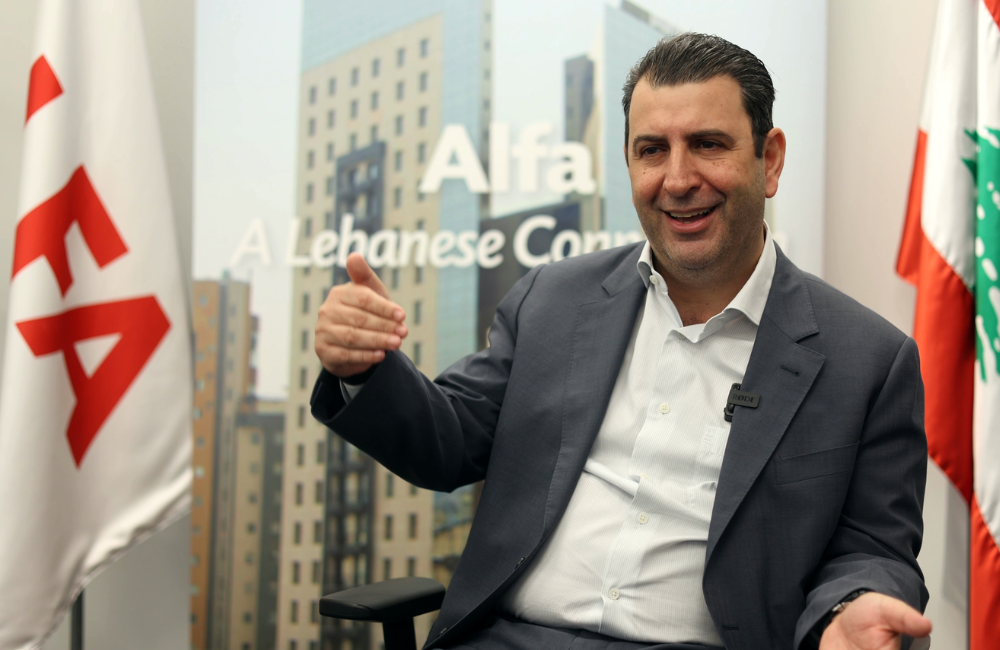
A Lebanese living abroad lands in Lebanon for the holidays, and the phone already works. That is the goal Rafic El Haddad, CEO of Alfa, has set for the operator's new eSIM service. "Our goal is that a Lebanese coming to spend the holidays in Lebanon has a line that is ready and active before they arrive," he told LeBusiness.
The interview, held in Arabic, went well beyond one product. El Haddad walked through Alfa's four-year plan, the 5G rollout, how the company protects customer data, where artificial intelligence fits, the obstacles slowing investment and the engineers he wants to bring back. Quotes have been translated into English.
A four-year plan on two tracks
Alfa drew up a four-year action plan in coordination with the Ministry of Telecommunications, and El Haddad calls it the basis for everything else. The first track is the network: modernizing the core network and the radio network, and bringing in 5G. Alfa already covers 99% of Lebanon's territory and 98% of its population, he said.
Digital transformation is the second track, which means moving Alfa's services online. For customers, the eSIM is the first place they will see it.
An Alfa line in about three minutes, without visiting a shop
An eSIM is a SIM card built into the phone, so there is no plastic card to collect. Alfa already offered eSIMs, El Haddad said, but getting one used to mean a trip to Alfa. "Instead of the citizen coming to us, we took this service to him," he said. Now the whole process runs on the Alfa app or the Alfa website.
Any Lebanese citizen can apply, whether they live in Lebanon or abroad. They need one of two documents: a valid biometric passport or a Lebanese ID card, which El Haddad described as an option specific to Alfa.
Supporting the ID card was the hardest part. Testing took more than a month, he said, because the card is not digital and carries no biometric data, and its Arabic details have to be converted so they read clearly in Alfa's English-language systems.
He described the steps in order. First, the customer picks a number: a standard prepaid line, a vanity number from Alfa's Chrome or Bronze ranges, or a mobile broadband number for internet only. Next, they scan their ID card or passport, confirm their details, add information such as their address and pass a face recognition check.
Payment comes after that. Once it goes through, the customer receives the same contract they would get at an Alfa shop or point of service, sent by email and WhatsApp, and the eSIM is active. The last step is choosing a service, voice or data, from Alfa's bundles.
"The steps are very easy," El Haddad said. The whole journey takes about three minutes, according to him. Alfa has received some comments from customers, he added, and will take them into account to make the process easier still.
Why it took until now
El Haddad tied the timing to Lebanon's financial crisis. The country lived through a long and difficult period in which investment stopped, he said. "This service existed before. But we did it today because we invested in the infrastructure and we took the decision to transform digitally."
Progress in AI helped too. AI systems now read customers' documents during sign-up, and they work well, he said. "We can't say any particular day is the right time, because technology keeps evolving," he added.
Foreign passports come next
Opening the online eSIM to foreigners with foreign passports is the next step. Alfa is in contact with Lebanon's security agencies to work out how to do it securely, El Haddad said.
From a technical point of view, he sees no problem: the system that works with Lebanese biometric passports can work with foreign ones. The question is responsibility. Today, a foreigner who wants a SIM at an Alfa store must show a passport, and Alfa checks it for an entry stamp or a visa, a duty that normally falls on telecom companies.
Doing that check online raises the question of who carries the responsibility for it, he said. The issue was on the table at a meeting at the Ministry of Telecommunications on the day of the interview, with a decision expected. On the technology side, he said a foreigner may not be able to complete the process before arriving, and mentioned checking for a Lebanese IP address on the app as one option.
Lebanese abroad already have that head start. "We try to get there before they arrive," he said, describing what Alfa has done for Lebanese living abroad who come home for Christmas.
Lost phones, SIM swaps and where the data lives
One of the most common customer questions is what happens if a phone with an eSIM is lost or stolen. El Haddad said the customer should report it to Alfa so the line can be stopped, and complete the legal procedures. Alfa then deactivates the old eSIM and gives the customer a new one.
A bigger worry is SIM swap fraud, where someone moves a person's number onto a new SIM to take over their accounts. Every system Alfa installs comes with up-to-date cyber security, El Haddad said, built to protect subscribers and their data. He said it has not happened, and that Alfa has taken measures inside its systems and firewalls to prevent it.
Alfa keeps its data on its own servers rather than in the cloud. The most important point, he said, is that the data is not stored in the cloud, even though much of the world is moving that way, because Lebanon's security agencies require it. The servers are protected by dedicated cyber security systems, and a department of 10 engineers works on cyber security.
Digital transformation means nothing if the data is not secure, El Haddad said. He did not promise perfection. Repeating a point he said the prime minister made at a meeting the day before, he said nothing is 100% secure, but Alfa does its part, and he noted the many breaches seen in Europe today.
5G: 12 sites today, around 85 by early 2027
"We were the first to launch 5G," El Haddad said. Alfa ran 10 trial sites during the Pope's visit, then went live in July 2026. Today it has 12 5G sites on air, and by the first month of 2027 it expects to have around 85.
Coverage starts in administrative Beirut, meaning the Centreville area and the government headquarters, plus the port, the airport and the Metn coast. Major cities come next, including Jounieh, Jbeil and Batroun, and above all Tripoli, where Alfa has its largest market share. The equipment is already in Alfa's warehouses, he said, and is being installed step by step.
Early demand is good, he said, and 5G is already easing pressure on the 4G network. A second phase will be a tender carried out over two to three years. Under that strategy, Alfa plans to fully modernize all of its 4G sites and add 5G to more than 70% of them.
War has pushed the timeline back. A plan that was meant to run from 2026 to 2029 will now run from 2027 to 2030, he said, because big investments do not happen in wartime.
Frequencies, money and war: three obstacles
El Haddad named three main obstacles. The first is frequencies, the slices of radio spectrum a network runs on. Alfa wants long-term frequencies, and he said this is the first time Lebanon has dealt with frequencies with this level of responsibility.
That question has to be settled before anything else, he explained. Alfa needs enough spectrum for a real 5G experience, and it cannot launch a tender until it knows which frequency it will use, because the equipment is built for a specific frequency.
Money is the second obstacle. Alfa is owned by the Lebanese state, and El Haddad said he understands that the treasury, with all of the country's problems, needs revenue, and mobile operators are among its biggest contributors. Alfa tries to balance those revenues against developing the network, he said, because a better network lifts the economy, creates jobs and in turn brings more revenue to the state.
He sees that balance as the obstacle to overcome in 2027. The third is the war. "In war, there is no investment, there is fear and there is destruction," he said.
Alfa lost 40 sites in the south. Even so, the network is back to 90% in the areas teams can reach, helped by cells on wheels, which are mobile towers on trucks. Alfa deployed 7 or 8 of them in the south, and today they serve 150,000 subscribers in 35 towns, he said. "But this is a temporary solution, and we are going back to the permanent solution."
Three places AI is entering Alfa
Alfa's four-year plan is set, El Haddad said, and the one thing being added to it is artificial intelligence, which the company has already started using. AI is at work in three places.
First is the online onboarding customers go through when they sign up for an eSIM, including face recognition, which runs on AI systems. Second, Alfa has approval to invest in its network management system, the Network Operations Center, so AI can handle what the company calls the first level of support.
Today, engineers watch the network and spot faults by hand, he said. With AI, more of that work and its analysis will happen without human intervention, and the system is expected within six months.
Third is customer service. Alfa started small with a chatbot, and it now plans an AI agent in its call center. "It speaks Lebanese, answers you in Lebanese and can help you," he said. Alfa is running a tender for it, and in principle it should arrive in 2027.
Bringing engineers back to Alfa
For all the talk of technology, El Haddad kept returning to people. "Technology is very important, but technology is there to serve people and to grow the economy," he said. He calls Alfa's staff the Alfa family and says they are its foundation.
Over the last five years, Alfa lost 350 employees, including 150 engineers, he said. Today they bring their expertise to large companies in Europe and the Gulf.
His goal is to reverse that. If investment returns and Lebanon has stability, in security and in the economy, he wants to bring engineers back into the company and learn from their expertise in new technology, AI and 5G. "We improve the service, but at the same time we create an environment that supports the Lebanese economy, the digital economy, and gets people working in Lebanon again," he said.
A Mediterranean route for broadband
El Haddad also sees an opening in Lebanon's location. Everything happening in the region, he said, confirms the value of Lebanon's position on the Mediterranean. If the country reaches stability, it could become a corridor, whether for oil heading abroad or for internet traffic.
He gave an example: countries that want to reduce their exposure to the Strait of Hormuz could receive broadband capacity from Europe through Lebanon. That strategy belongs to the Ministry of Telecommunications and the telecom regulator, he said, adding that he hopes it gets resolved.
For El Haddad, the conditions come down to two things. "If there is fast internet and security in the country, I believe Lebanon's future is very big," he said.
 Alfa