In Lebanon, a lot of life happens around a table. People welcome guests with food, spend their evenings over long meals, and close business deals over dinner. Tamr, a new Beirut startup, is built on a simple frustration with one part of that ritual: the menu itself.
For most restaurants, the menu is a static PDF. A guest reads it, but it cannot read them back. If they have a question, there is often no one to ask. And the owner never finds out what was asked, or what the table was looking for and could not find. Tamr is trying to change that by turning the menu into something a guest can talk to.
How a static PDF becomes a conversation
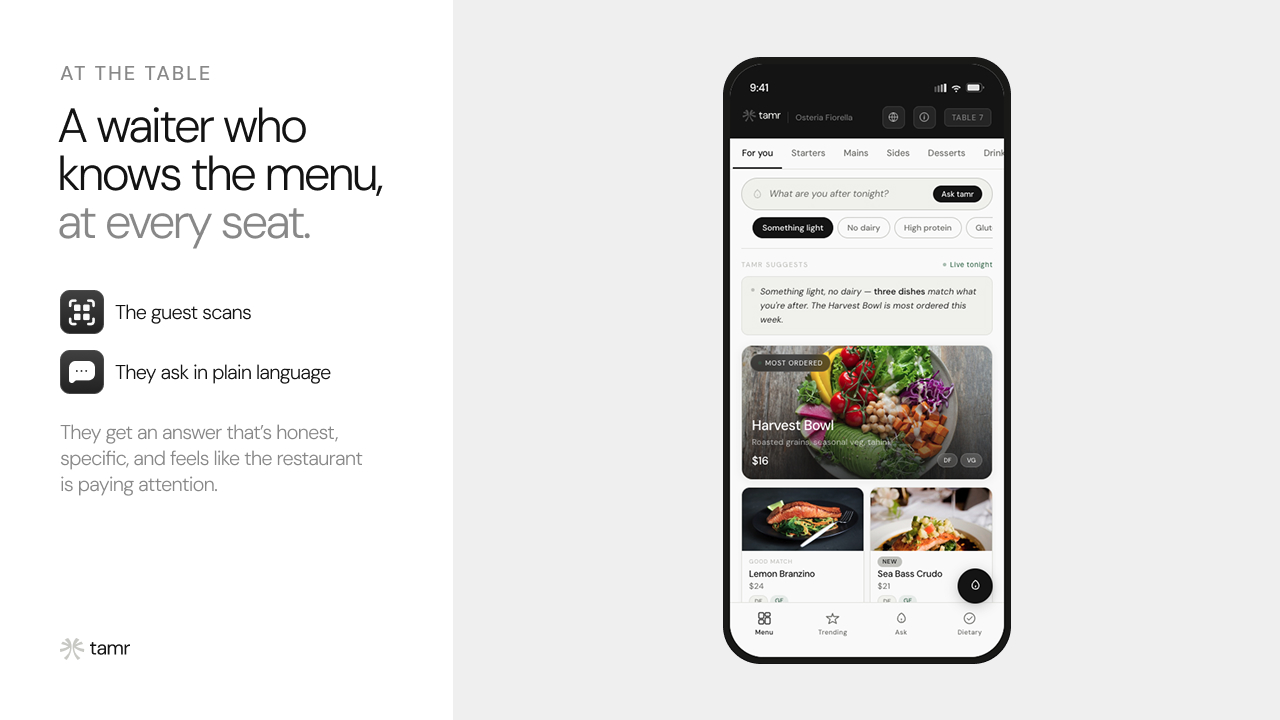
The idea is straightforward. A guest scans a QR code at the table, then asks the menu anything in plain language. Instead of scrolling through a list, they get a specific, honest answer from a named digital waiter. Someone can ask for something light with no dairy, check whether a dish is gluten free or halal, or simply ask what is good tonight, and get a reply that fits them.
Tamr reads questions in Arabic, French, and English, which matters in a market where guests switch between all three in the same sentence. A diner who types a question in Lebanese Arabic gets the same answer as one who types it in English. There is no app to download and no login; the guest scans and starts asking.
What owners see while the evening is still on
The second half of Tamr faces the restaurant owner. Every question a guest asks becomes a signal the owner can see in near real time, not weeks later in an end-of-month report. Owners can watch what guests are asking, which dishes are being suggested and ordered, and where the gaps are while service is still happening.
That is the part the founders believe restaurants have been missing. As Josef puts it, owners "finally hear what every guest wants." The tables have always held that information. Tamr is trying to make it visible.
The brothers behind it
Josef Abi Aoun and Ayman Abi Aoun are co-founders and brothers who grew up inside Lebanon's food and hospitality culture. Both come from a B2B and SaaS background, and they say they built Tamr to hold up in real restaurants from day one rather than as a demo.
Their reading of the market is that plenty of companies jumped into restaurant tech but stopped at putting the menu on a screen. They saw a missing layer between the guest and the kitchen: a digital waiter that actually answers questions, and a view for the owner of what those questions reveal.
Where Tamr is starting
Tamr is launching now. Over recent weeks the founders have been meeting some of the largest food and beverage players in the market, and they say the response has been consistent: operators understand it quickly and want it on their tables. The company's social channels go live in the coming week, with a wider go-to-market push to follow, starting in Lebanon and the wider MENA region.
For a product built around hospitality, the founders frame the ambition in those terms too. "For a hundred years the menu just sat there," Josef says. "Tamr's AI waiter knows the whole menu and knows you: it learns your taste and recommends exactly what you'll love. And owners finally hear what every guest wants."
Learn more about Tamr.