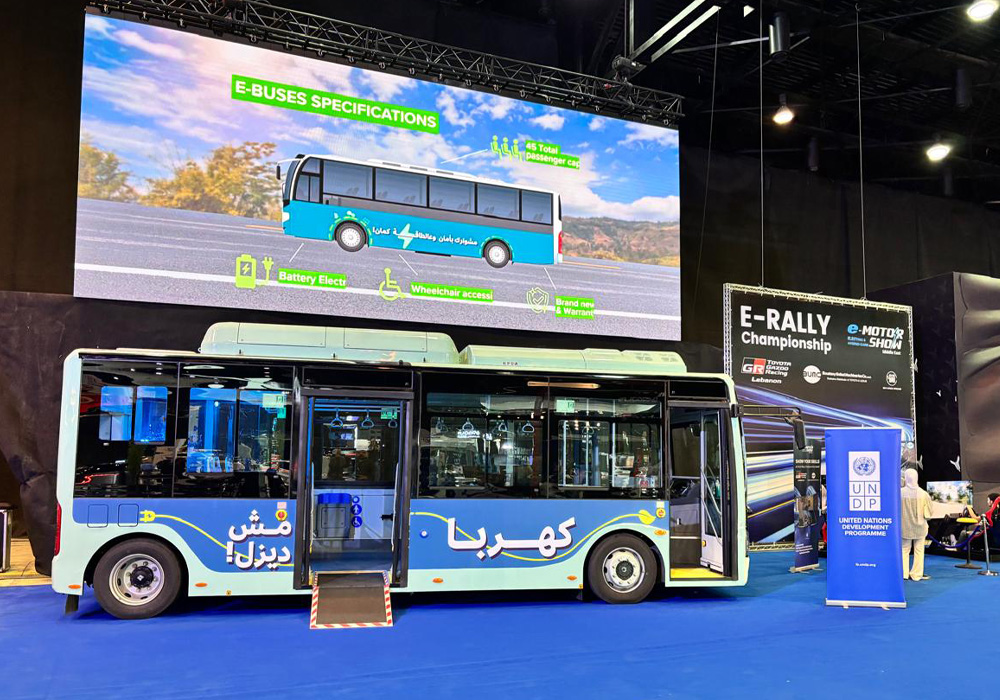
Lebanon has officially launched its first electric public transport line, with four fully electric buses now running between Beirut and Byblos. The line is operated by the Railway and Public Transport Authority in partnership with ACTC, the Lebanese transport operator.
Seven stations sit between the two cities. Solar panels at the Jbeil Bus Station handle the charging, and a central operations room monitors the buses in real time. A one-way fare is set at LBP 200,000.
A 150,000 Commuter Plan
The Ministry of Public Works and Transport expects around 150,000 commuters to use the line every year. Beyond moving people, the project is built to reduce traffic congestion, cut roughly 900 tonnes of CO2 equivalent emissions a year, and lower dependence on private cars on the Beirut to Jbeil corridor.
All four buses are wheelchair accessible. The ministry says the design is meant to make the service usable for students, older commuters, and people with disabilities.
Rasamny Calls Public Transport "A Right"
At the launch, Minister of Public Works and Transport Fayez Rasamny described the project as a foundational step toward rebuilding Lebanon's public transport sector on modern and sustainable grounds. He called public transport "a fundamental right and a pillar of any productive economy."
That framing carries weight in a country where, for years, intercity mobility has fallen almost entirely on taxis, vans, and private cars after the old rail and bus networks collapsed.
From Qatari Buses to a Tripoli Rail Plan
The electric line plugs into a wider effort. Lebanon now has 11 active public transport routes carrying more than 7,000 passengers a day, according to the ministry.
In the coming weeks, buses donated by Qatar are expected to enter service on six additional routes. The ministry is also preparing a Byblos to Annaya line running toward the Saint Charbel shrine, a major pilgrimage destination.
Further out, the government is reportedly working on rail plans linking Tripoli Port to the Syrian border, a route with clear commercial and trade implications if rebuilt.
The Gap That Remains
Even with the electric launch and the incoming Qatari buses, the distance between today's network and a functioning nationwide system is wide. Eleven routes and a few thousand passengers a day is a starting point, not a transport network.
For now, the Beirut to Byblos line gives Lebanon something it has not had in years: a clean, scheduled, public way to move between two of its busiest cities.