For ISPs across the MENA region, the rollout of 5G and IoT comes with an expensive side effect: networks are getting more crowded, and the radio frequencies they depend on are getting noisier. By one industry estimate cited by AirGuard, a Lebanese deep-tech startup, up to 40% of all service outages are caused by RF noise and spectrum interference. AirGuard has built a hardware-and-AI product to bring that number down.
How the System Actually Works
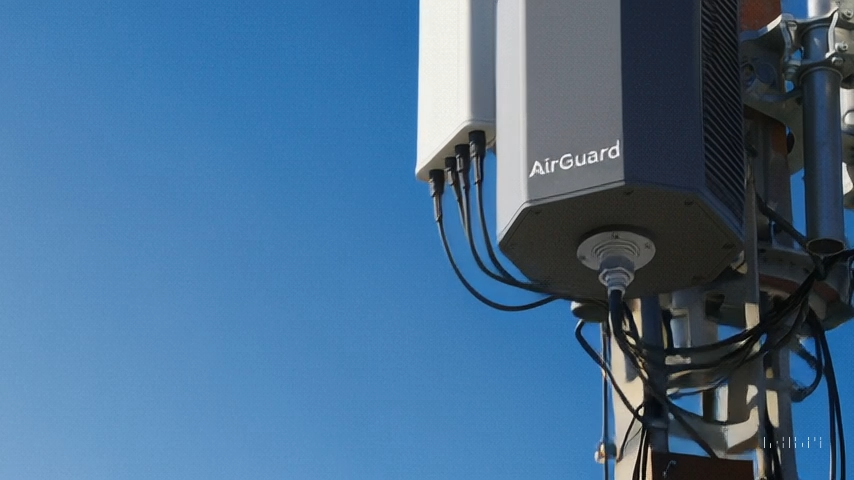
AirGuard is a hardware-enabled SaaS platform that bolts onto an operator's existing network infrastructure. Its device sits on cell towers and rooftop sites, scans the surrounding spectrum in real time, and uses on-board AI to identify and classify sources of interference before they degrade customer service.
The platform is built around three core capabilities. A custom 8-antenna array delivers 360-degree real-time spectrum scanning, locating and classifying RF interference from any direction. An on-device AI model, running on NVIDIA Jetson Orin Nano hardware, analyzes the environment and predicts issues before they hit customers. Once an issue is detected, the system can autonomously retune channel configurations in under a second to keep the network performing.
Who Is Building AirGuard
AirGuard is led by Ryan Kyrillos, the company's founder and CEO, alongside co-founder and CTO Chris Kareh, whose background sits in embedded systems and edge computing. They are joined by network and security specialist Elias Cheikh, product designer Ramona Baysari, and senior frontend developer Anthony Saliba.
The company is backed by the Lebanese American University, Clyntech, and ACIE, three of the organizations supporting deep-tech founders in Lebanon.
How AirGuard Makes Money
AirGuard's commercial model is built around recurring software revenue layered on top of its hardware. The core subscription is priced at $125 per month per device, with optional add-ons for advanced predictive AI at $40 per month and advanced analytics at $30 per month.
Operators also get a cloud dashboard with fleet-level visibility across their deployed devices, and a LoRaWAN backup channel is built in for resilience if the primary network link goes down.
What the System Delivers for ISPs
The pitch to ISPs is straightforward: lower downtime, lower costs, lower power draw. AirGuard cites a 35% reduction in network downtime, a 30% reduction in operational costs, and a 20% reduction in network power use among the operational gains its technology delivers. The company also frames its impact in environmental terms, citing 240 tons of CO2 emissions, 210 megawatt hours of electricity, and 320 kilograms of e-waste saved per year.
Where the Money Is in MENA Network Automation
AirGuard puts the global network automation market at $31 billion in 2025, with the MENA slice worth around $2.1 billion. Its initial target is the GCC ISP market, which it sizes at $85 million. Government-led 5G and IoT expansions across the region are driving the densification problem the company is selling into.
From Pilots to a Gulf Sales Engine
The roadmap is staged. In year one, AirGuard plans to secure three to five paid pilots with major MENA operators, finalize production hardware, and build out case studies. In year two, the focus shifts to commercial scaling in Saudi Arabia and the UAE, including building an in-house sales team and onboarding telecom system integrators as channel partners. In year three, the company plans to expand into Egypt and Qatar, launch an enterprise tier, and add 6GHz band support.
Strategic Partners and Early Validation
Alongside its commercial push, the team is openly looking for strategic partners in manufacturing and supply chain, legal and regulatory compliance, and IP strategy.
Validation, AirGuard says, is already coming from operators on the ground. "Managing RF interference in our dense urban 5G network was a constant battle.
AirGuard's prototype gave us proactive visibility for the first time, allowing us to fix issues before customers were impacted," said Steve Romano of a major regional ISP in Byblos.
Learn more about AirGuard.