Lebanon's Land Registry recorded 34,083 property sales worth about $3.70 billion between January and August 2026, according to BLOMInvest Bank's reading of the registry data. The market is still moving, despite a year of renewed conflict. But a national figure cannot tell an owner what one particular building is worth, and for Lebanese families who own property at home while living abroad, that gap is the whole problem.
Cedar Keys Estates, a Beirut real estate and property advisory firm founded in 2025, has built its business around that gap. Here is what the published figures show, what they leave out, and the four things the firm says any owner should check before trusting someone with a property they cannot visit.
What the numbers actually say
Lebanon publishes very little about its own property market. What exists is often scattered, released late, or available only through personal contacts. In a market without published information, whoever holds the information sets the terms of every deal.
The figures that do exist are worth reading closely. Sales value has held up far better than sales volume this year. Over the first five months of 2026, transaction value was down 17.79% year on year, according to Credit Libanais figures cited by Executive Magazine. By the end of July, that gap had narrowed to 5.36%, at roughly $3.25 billion, even though the number of sales was still about 25% lower than a year earlier.
Cedar Keys Estates' own reading of the registry data, published in its market insights, differs slightly. It puts the January to August total at 34,549 sales worth $3.74 billion, with the value gap narrowing from 17.8% in May to 3.8% by August.
Put simply, fewer properties are changing hands, but the deals that do go through are larger on average.
Cedar Keys Estates has also studied the longer record. According to the firm's own research, only four years between 2019 and 2026 have fully published registry figures, three were never published at all, and figures from the Lebanese pound era and the dollar era cannot honestly be joined into a single trend line.
Foreign ownership is smaller than many people assume. The firm's analysis of registry data counts 92,930 non-Lebanese owners holding 0.383% of Lebanon's land by area, rising to 6.22% inside Beirut. The law caps foreign ownership at 3% of the country and 10% of Beirut, according to IDAL. Foreign demand, in other words, is concentrated in the capital rather than spread across the country.
What none of these numbers can do is price a specific building. Registry data describes a district. It does not describe a floor, a view, a lift that has not worked since 2021, a deed shared between four heirs, or a registration that will stall the week after signing. Those are the details that decide what a property actually sells for.
The owner is abroad, the property is not
Every buyer and seller in Lebanon deals with that gap. Owners who live outside the country deal with it blind.
Many Lebanese families own property at home while living somewhere else. Some rent out the apartment they grew up in. Some hold land.
Some have inherited a share of a building with relatives spread across three countries, and nobody on the ground who can speak for it. They cannot walk into the property, and they cannot check what they are told.
According to Cedar Keys Estates, that leads to the same problems again and again. A property is listed at a number based on what a neighbour claims they were offered, not on what actually sold, and it sits on the market for six months.
A tenant issue comes to light when it is already expensive, instead of when it was a phone call. A sale is agreed, then stalls on a registration nobody checked, or on a deed that does not transfer cleanly after the buyer has signed. And the work usually lands on one relative in Beirut who never asked for the job and has no authority to settle anything.
Distance alone does not cause this, the firm argues. Distance combined with nothing verifiable to rely on does.
Four things to check before trusting anyone with a property you cannot visit
One: is someone physically there, on a schedule? Not someone who will go if you ask, but someone who inspects the property on set dates whether or not anything seems wrong, and reports back on what they found. Most building problems are cheap in month one and serious by month twelve. What reliably catches them is a person standing in the room on a date agreed in advance.
Two: is the valuation evidence, or opinion? Ask what a figure is based on. If the answer is recent asking prices, be careful: in Lebanon today, asking prices and recorded sale prices are not the same number, and the distance between them is what leaves properties unsold.
If the answer is recorded transactions, ask which ones. And be wary of any figure for a property nobody has entered. As the firm puts it, a valuation without an inspection is a guess with a decimal point.
Three: who handles the legal file, and when? Registration, title deed transfer and government paperwork are where Lebanese deals actually fail. Many agencies refer this work out, which means nobody examines it until a deal is already agreed. Ask who does it and, more importantly, when: before you are committed, or afterwards, when the problem has become yours.
Four: is it in writing, and will they tell you no? Terms, mandates, fees and the scope of the work should all be on paper. A handshake is not a position anyone can be held to from four thousand kilometres away.
An adviser who agrees with every price you suggest is not really advising you. A willingness to say your number is not supported, at the start rather than six months in, is the clearest sign you are being advised rather than sold to.
One firm's answer
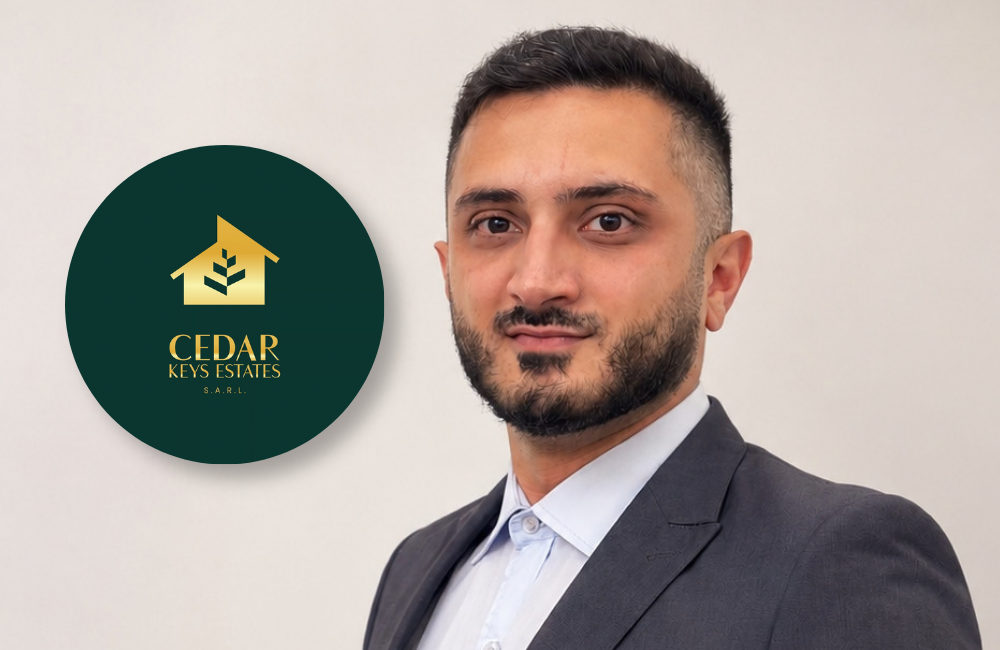
Cedar Keys Estates was founded in Beirut in 2025 by Mustapha Fouladkar, REALTOR®. It is a member of REAL, the Real Estate Syndicate of Lebanon, and handles sales, rentals, property management, valuation, registration and title deed transfer. The firm says it was built around those four questions.
The approach started before the company did. As a student, Fouladkar took on a 10,000 square metre warehouse that nobody would rent because it was too large for one tenant. He divided it into eleven units, let all eleven, and ran the contracts himself. Those eleven contracts taught him how much of property sits on the legal side, and how few brokers were willing to touch it.
On presence. For owners abroad, property management is a standing service, not a favour between deals. It covers finding and vetting tenants, collecting rent, drawing up and renewing contracts, coordinating maintenance and repairs, inspecting on a schedule, and reporting what was actually found.
Paperwork such as registrations, deed matters and municipality files is handled in Beirut, because that is the part a distant owner cannot do from a phone. The firm's own test is simple: an owner should not have to fly home to learn what is happening inside their building.
On valuation. Every valuation starts with an inspection, and the firm does not issue a figure for a property it has not seen. It prices against recorded transactions rather than asking prices. It also publishes its underlying research, including registered sales month by month and year by year from 2019 to 2026, and foreign ownership of Lebanese land across all 25 districts.
Alongside the data, it writes about how the market works in practice at cedarkeysestates.com/articles. That section is open to outside professionals in property, law, architecture, construction, finance and urban planning. The firm does not pay for articles, does not publish advertising as editorial, and edits only for clarity and accuracy. When it cannot publish something, it says so and explains why.
On the legal file. Registration support, title deed transfer, government paperwork and document preparation are done in house rather than referred out. The firm raises what it finds before a client is committed, not afterwards.
On accountability. Terms, mandates and scope go in writing. The firm declines work, and tells an owner at the start when a price is not supported by what has sold nearby. That costs it mandates, but in its view it is the only thing that makes the advice worth anything.
Its clients range from a tenant looking for a first apartment to businesses with whole building requirements. Its stock covers apartments and villas, shops, offices, showrooms, warehouses, industrial space and land. Some of it never appears in a public listing: off market property kept for private viewings, for clients whose needs are specific enough that an advert would not reach them.
Once the Lebanese property is under control
An owner who knows what their property is worth, has someone accountable inside it, and holds a clean file can finally make a decision about it, rather than putting one off. For a growing number of the firm's clients, that decision is to stop holding everything in one country.
Cedar Keys Estates works through vetted partner agencies abroad rather than claiming to operate overseas itself. Its current international portfolio is in Türkiye: eight residential developments in Istanbul and Izmir, listed project by project with starting prices, unit layouts and delivery status, from ready to move in through to completion in 2027. When a client asks about a market the firm is not yet active in, it takes the request on and sources the property rather than turning the client away.
What a client gets is a judgement rather than a brochure: which market, residential or commercial, off plan or ready, which payment structure fits, and which developer the firm is prepared to stand behind. Returns are never presented as guaranteed, and a delivery date is what the developer has committed to in writing, not what the firm hopes for.
Credentials anyone can check
Cedar Keys Estates S.A.R.L. can be verified in REAL's member directory. Fouladkar is an International REALTOR® Member (IRM) of the National Association of REALTORS® (NAR) in the United States, and is listed in its member directory. The firm's website carries a page for every property it represents and a guide for every area it works in.
For a firm founded in 2025 with no inherited relationships, that public record is the argument. Anyone weighing a deal can check who they are dealing with before they sign.
"I walk into a property through the eyes of the person buying it, not the person selling it," Fouladkar says. "Integrity may cost you a transaction. It builds a reputation that outlasts the transaction."
REALTOR® is a federally registered collective membership mark that identifies a real estate professional who is a member of the National Association of REALTORS® and subscribes to its strict Code of Ethics.
See listings, area guides and market research at cedarkeysestates.com.
 Cedar Keys Estates