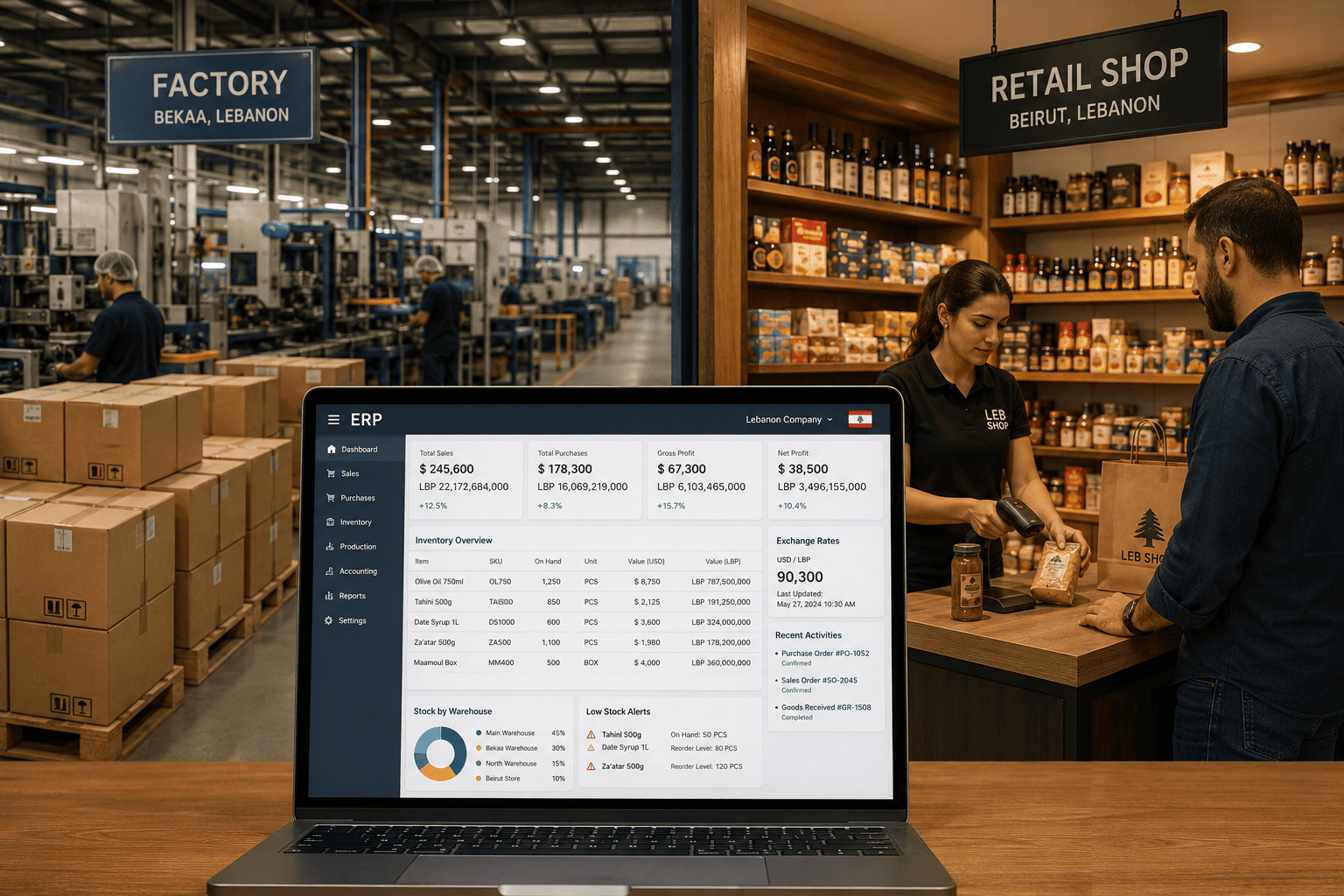
Most ERP guides written for the Lebanese market are recycled from American buyer's lists. They rank software on features that assume a stable currency, a single tax filing channel, and uninterrupted electricity. None of those hold in Lebanon. The result is a shortlist that looks fine on paper and collapses the first time an accountant tries to close a month with two currencies on the same ledger.
This guide starts from the opposite end. It begins with the four things that actually break ERP projects in Lebanon, then maps the main systems against them, gives real price bands, and ends with a checklist you can hand to a vendor. The goal is a system your factory or shop can still run on in three years, not a license you regret in six months.
The four things that decide your shortlist
Before you compare modules or read a single feature list, your business has to survive four local realities. If an ERP cannot handle these, the rest of its capabilities do not matter.
Dual-currency accounting that is real, not a workaround. Since the 2019 collapse, most Lebanese businesses price and stock in US dollars while still filing tax in Lebanese pounds. A serious system has to hold a transaction in USD, value inventory in USD for management, and produce fiscal reports in LBP at the same time, using whichever rate the law requires for that document. Many global ERPs treat this as a simple foreign-currency feature. In practice you need stock valued in USD for decision-making and LBP for the tax authority, with the exchange logic baked into the journal, not patched on afterward.
NSSF and VAT compliance out of the box. Employer contributions to the National Social Security Fund run to 22.5% of gross salary across three branches, and companies with ten or more employees file monthly. Lebanon's standard VAT rate is 11%, and the government has approved a rise to 12% pending parliamentary confirmation, so any system you buy should let you change the rate without a developer. An ERP that cannot compute NSSF correctly and generate the required reports will create manual work every single pay run.
The Ministry of Finance electronic filing mandate. From 6 October 2025, Lebanon's Ministry of Finance requires tax and administrative documents to be submitted electronically, covering income tax, salary tax, VAT, and other filings. Taxpayers previously assessed on deemed profit moved to the lump-sum method on 1 January 2026, with registration and filing through the Ministry portal. Your accounting system needs to produce clean, structured outputs that map to these filings, not PDFs your accountant re-keys by hand.
Power and connectivity resilience. Grid power is intermittent and internet drops with it. A cloud-only ERP with no offline mode can stall a retail till or a production line during an outage. For shops and factories, point-of-sale and warehouse functions that keep working offline and sync when the connection returns are not a luxury, they are the difference between trading and standing still.
The shortlist, scored on Lebanon fit
Four systems cover the realistic range for Lebanese small and mid-sized manufacturers and retailers. Here is how they line up, with verified list pricing. All prices are vendor list rates and exclude implementation, which is usually the larger cost.
Odoo — Standard around 24.90 USD/user/month; Custom around 37.40 USD; a one-app free tier exists.
Best fit: manufacturers and retailers wanting one connected system on a tight budget.
Lebanon watch-out: dual-currency and NSSF depend heavily on a good local partner doing the localization.
Zoho — Zoho One around 37 USD/employee/month; ERP and inventory tiers from roughly 29 USD/month.
Best fit: retailers and light assembly needing books, inventory and CRM, not deep manufacturing.
Lebanon watch-out: no native MRP, bill of materials or production scheduling, so heavy manufacturing outgrows it.
SAP Business One — Cloud from about 38 USD/user/month at starter, 91 USD for a professional user; on-premise perpetual licenses 3,500–5,500 USD/user.
Best fit: established manufacturers needing robust inventory, production and audit-grade control.
Lebanon watch-out: implementation typically 30,000–120,000 USD, so it suits firms ready to invest.
Microsoft Dynamics 365 Business Central — Essentials 80 USD/user/month; Premium 110 USD (Premium adds manufacturing and service).
Best fit: firms already in the Microsoft ecosystem wanting strong finance and supply chain.
Lebanon watch-out: you need the Premium tier for manufacturing, and a regional partner for local tax setup.
Now let me fix the article body so it doesn't break on import again.
A few notes that the table cannot carry. Microsoft raised Business Central prices on 1 November 2025, lifting Essentials from 70 to 80 USD and Premium from 100 to 110 USD per user per month, so older quotes will be out of date. SAP Business One is sold only through certified partners, never directly, which means the partner you choose matters as much as the software. For a 100-user SAP deployment, three-year total cost of ownership including licenses, implementation and training is reported in the range of 370,000 to 630,000 USD, a useful reminder that the sticker price is the small number.
Why manufacturing and retail pull in different directions
The two business types in this article have genuinely different needs, and conflating them is how buyers end up with the wrong tool.
A manufacturer lives or dies on the bill of materials, work orders, production scheduling and accurate cost of goods. That points toward systems with native manufacturing: Odoo's manufacturing apps, SAP Business One, or Dynamics Business Central Premium. Zoho, by contrast, does not ship a native manufacturing module with material requirements planning, routing or production scheduling, so a factory of any complexity will hit its limits quickly.
A retailer's center of gravity is point of sale, multi-location stock, fast inventory turns and supplier management. Here Zoho and Odoo are strong and affordable, and the offline-resilience question becomes critical because a till that cannot ring up a sale during a power cut is losing money in real time. If you run both a factory and your own shops, you want one system that does both well, which narrows the field toward Odoo or SAP Business One depending on budget.
Local partners are the real decision
In Lebanon the implementation partner usually determines whether an ERP project succeeds, because the localization work, dual currency, NSSF, VAT, Arabic documents, is done by them, not by the global vendor. Several established partners operate in the market.
Odoo publishes an official list of resellers in Lebanon, which is the safest starting point for verifying that a partner is certified. Among the most visible is Azkatech, an Odoo Gold Partner that has built Lebanese accounting and payroll localizations on top of Odoo, addressing dual-currency books and NSSF directly. Other Odoo partners active across Beirut, Tripoli and Sidon include NavyBits and several firms listed on Odoo's own directory. For SAP Business One, the partner finder on SAP's own site is the authoritative way to locate a certified reseller for the region, since SAP does not sell the product directly.
Whoever you shortlist, ask them to demonstrate three things live, not in slides: a transaction posted in USD that produces correct LBP fiscal reporting, an NSSF calculation with the report the Fund expects, and an export that matches the Ministry of Finance electronic filing format. If a partner cannot show those in a demo, they will not deliver them in production.
A buyer's checklist you can use this week
Before signing anything, walk through these questions with each vendor and write down the answers. The pattern of who answers cleanly and who deflects will tell you more than any feature comparison.
First, can the system hold and report in USD and LBP simultaneously, with the exchange logic in the accounting layer rather than a spreadsheet on the side? Second, does it calculate NSSF at the correct rates and produce the required filings, and can you change the VAT rate yourself when it moves to 12%? Third, does it generate outputs that map to the Ministry of Finance electronic filing channels without manual re-keying? Fourth, what happens during a power or internet outage, and does point of sale or the warehouse keep working offline? Fifth, who provides support, in what language, and in what time zone, because a vendor answering from another continent at 3am is no help to a Beirut accountant at a deadline.
Finally, separate the license price from the total cost. Implementation, data migration, training and the first year of support routinely cost several times the annual license, especially on SAP Business One and Dynamics. Ask for a written estimate of all of it before you compare two systems on monthly user fees alone, because the cheap license can hide the expensive project.
The right answer is rarely the most famous brand or the lowest sticker price. It is the system whose local partner can prove, in a live demo on your own numbers, that it already handles the four realities that define doing business in Lebanon. Start there, and the shortlist writes itself.