B018, the underground club buried in Beirut's Karantina district, reopens its doors on the night of Saturday, July 4, ending a silence that lasted more than two years. The club announced the date on its social channels after months of speculation about a summer return.
Operations stopped in 2024 following a dispute tied to the site the club occupies. Few venues managed to fill the space it left in Beirut's nightlife, and its return was treated as major news by international outlets including Resident Advisor and Mille World.
A $200,000 Bet on Analogue Sound
Music direction now sits with Omran Gebran, son of founder Naji Gebran, who started the club's story with private listening sessions during the civil war that friends called musical therapy. His biggest call for the relaunch was the sound system: a fully analogue d&b audiotechnik U-Series rig, installed in Lebanon for the first time.
"We chose D&B because it offers the most balanced and precise sound experience across all genres of music," Gebran told NIGHTMAG. Total spending on sound reached around $200,000, covering the speakers, an Allen & Heath mixer, and new cabling across the venue. Rockwool insulation was packed into the mechanical systems before the structure was sealed to sharpen acoustics inside the hall.
Speakers are arranged for 360-degree coverage, so the sound is the same wherever you stand. There is no elevated DJ booth and no stage. Gebran says the goal is a room where people face each other instead of facing one direction.
The Building That Launched Bernard Khoury's Career
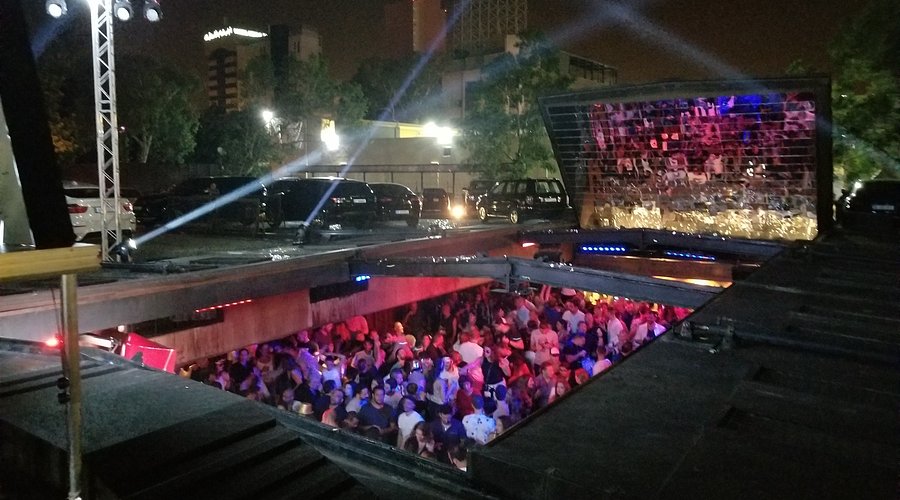
Architect Bernard Khoury designed the current B018, which opened on its Karantina site on April 18, 1998. It was the first building he ever constructed, drawn and delivered in six months, with the retractable roof its single most expensive element at $55,000. The main hall measures just 196 square meters.
That sunken, bunker-like design turned a small club into an architectural landmark. Wallpaper named B018 one of the world's best clubs in 2004, 2005 and 2006, and the building collected an honourable mention at the Borromini Prize in 2001 along with several Aga Khan Award nominations. It is still studied as a defining example of post-war Beirut architecture.
Back to the 1998 Blueprint
B018 survived the 2020 Beirut port explosion, which devastated Karantina, largely because its core sits below ground. Lebanon's economic collapse and commercial pressure wore the club down in the years that followed, until the 2024 dispute forced it to shut completely.
Khoury frames the relaunch as a correction rather than a comeback. "It's a reboot. The place is reclaiming its roots," he told NIGHTMAG. Naji Gebran himself may reportedly appear on quiet nights to play a few records. The roof still slides open to the Beirut sky, exactly as it did in 1998.