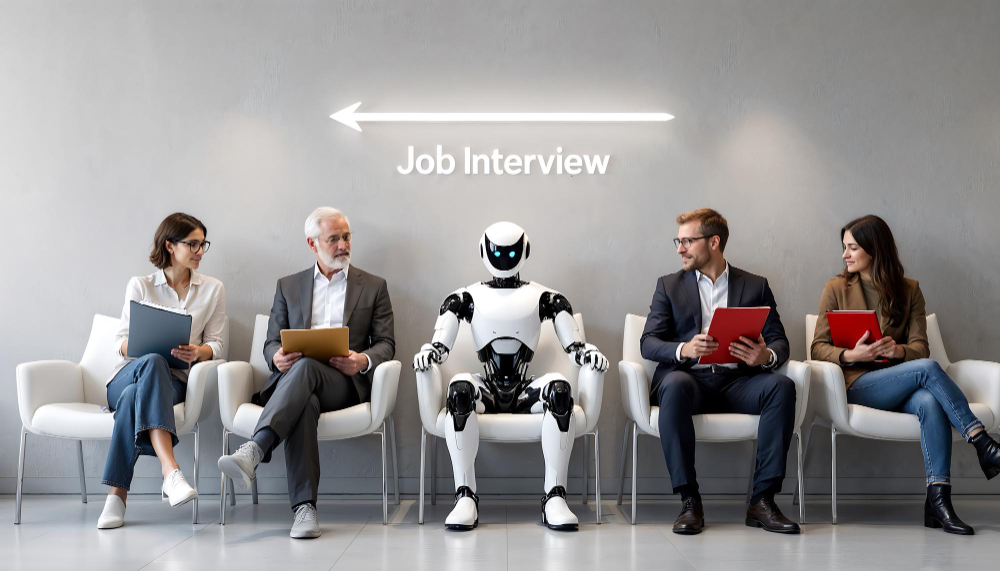
Every year, millions of students enroll in degree programs that were designed for a job market that is quietly disappearing beneath them. The tuition bills are real. The debt is real. But the entry-level roles those degrees were supposed to unlock are being automated out of existence before graduation day arrives.
This is not a distant threat. It is happening now.
Goldman Sachs estimates that 300 million jobs globally are exposed to automation by AI. The World Economic Forum's 2025 Future of Jobs Report found that 22% of all jobs will be structurally transformed by 2030, with 92 million roles displaced and 170 million new ones created — but that net gain means nothing to someone whose specific skillset sits in the declining column.
The problem is not that degrees have stopped mattering. It is that certain degrees train graduates for the layer of work AI absorbs first: the repeatable, the rule-based, the routine. And universities are updating their curricula far slower than the technology is moving.
Here are ten degrees where that gap is most dangerous — and what to do if you are holding one.
1. Generic Business Administration
A broad business degree with no specialization has always been a weak signal. AI has made it weaker. The tasks that business graduates were hired to perform — building reports, managing spreadsheets, drafting internal documents, running basic analyses — are now handled faster and cheaper by tools that never sleep and never ask for a raise.
The WEF's Future of Jobs Report 2025 forecasts a sharp fall in administrative and clerical roles, with accountants, auditors, and administrative assistants among the positions most exposed to displacement.
A generic business degree in 2025 is the equivalent of a blank CV. The graduates thriving are those who paired their business education with a genuine specialism — sales leadership, supply chain management, financial modeling, or operations. The ones struggling are those who assumed the degree alone would do the work.
Where the value still lives: Strategic thinking, stakeholder management, and the ability to sell ideas that cannot be reduced to a formula.
2. Basic Marketing Degrees
Content creation, ad copy, performance reporting, campaign analysis — AI tools now handle all of it at a fraction of the cost of a junior hire. The demand for entry-level marketing roles is contracting precisely because the work those roles performed has become automatable.
Goldman Sachs research notes that certain types of work — including copywriting — could be displaced by free or cheap AI tools, with the labor market effects already visible in online job platforms.
The marketing professionals who remain indispensable are the ones operating at the level of brand strategy, audience psychology, and creative direction — roles that require taste, judgment, and the ability to read a room. Those who were trained primarily to execute campaigns and write copy face a narrowing market.
Where the value still lives: Brand positioning, creative direction, and understanding human behavior well enough to direct AI rather than compete with it.
3. Journalism and Media Studies
AI produces articles, summaries, breaking news alerts, and financial reports at scale and speed. The Associated Press and Bloomberg have been using automated writing systems for years. The entry-level newsroom jobs that used to serve as training grounds — wire reporting, data aggregation, basic news writing — are shrinking.
Goldman Sachs economists have documented that younger workers in knowledge and creative sectors, including media, are among those seeing early displacement pressures as AI reshapes hiring.
Investigative journalism, opinion writing, and personality-driven content are different. They require original sourcing, moral judgment, and a distinctive voice — things no language model can manufacture. The journalists building durable careers are the ones who have staked out a specific beat and made themselves the most informed, most trusted voice on it.
Where the value still lives: Original reporting, subject-matter expertise, and the ability to tell stories that require human access and human judgment.
4. Communications Degrees
Internal messaging, press releases, media pitches, executive communications — AI drafts all of it competently. Communications as a discipline was already broad and somewhat vague in its career outcomes. AI has tightened that problem considerably by automating the most teachable parts of the job.
The WEF's 2025 report found that 41% of employers globally plan to reduce their workforce in areas where AI can automate tasks — and communications functions are among the most exposed to that pressure.
The professionals commanding respect in communications today are not the ones who write well. Writing well is table stakes and AI has cleared that bar. The ones winning are crisis managers, reputation strategists, and executives who understand that communication is fundamentally about power, trust, and influence — not grammar and formatting.
Where the value still lives: Crisis management, executive coaching, and the kind of institutional credibility-building that takes years and relationships to develop.
5. Paralegal and Pre-Law
AI reviews contracts, identifies relevant case precedent, drafts legal summaries, and flags compliance issues in seconds. The mid-tier of legal support — the work that paralegals and junior associates used to bill hours performing — is being absorbed by legal AI platforms at a rate that is making law firms rethink their entry-level staffing models.
McKinsey research estimates that 47% of US jobs contain tasks that are highly automatable, with legal and administrative support among the categories carrying the highest exposure.
The legal profession still richly rewards expertise. Senior partners, trial lawyers, and deal-makers who operate at the level of judgment, persuasion, and strategy face no credible AI threat in the near term. But the path to those roles has always run through the middle layers — and those are thinning.
Where the value still lives: The courtroom, the negotiating table, and the advisory relationship between a trusted lawyer and a high-stakes client.
6. Surface-Level Computer Science
Here is the counterintuitive one. AI writes code. It debugs programs. It scaffolds entire applications from a prompt. The wave of non-technical founders "vibe coding" products into existence in a weekend is real, and it is putting pressure on the entry-level developer market at exactly the moment when a generation of CS graduates is entering it.
Unemployment among 20- to 30-year-olds in tech-exposed occupations has risen by almost 3 percentage points since the start of 2025, notably higher than for their same-aged counterparts in other industries — a pattern Goldman Sachs Research attributes to AI automation affecting entry-level hiring.
The CS degree is not worthless. Far from it. But a CS degree without genuine depth — in systems architecture, machine learning, security, or the intersection of AI and a specific industry — lands graduates in a crowded market where AI is their direct competition for the same work.
Where the value still lives: Deep systems thinking, AI infrastructure, and the ability to build things AI cannot build alone.
7. Accounting
Bookkeeping, reconciliation, payroll processing, and standard financial reporting are rules-based tasks. They follow logic trees. They involve no ambiguity. These are exactly the conditions under which AI performs best, and the accounting profession has known this was coming since automation started eating data entry a decade ago.
The WEF's Future of Jobs Report 2025 explicitly names accountants and auditors among the roles facing the sharpest employment decline between now and 2030.
The profession still needs humans. Tax strategy, forensic accounting, complex financial interpretation, and the kind of advisory work where a client needs a trusted person to tell them what the numbers actually mean — these are not automatable yet. But the entry and mid-level tier, where most accounting graduates begin their careers, is where the compression is hardest.
Where the value still lives: Advisory services, tax strategy, and the human judgment that complex financial decisions still require.
8. Finance (Entry-Level Track)
Spreadsheet modeling, equity research reports, deck building for pitches — AI does all of this faster than a first-year analyst. The junior Wall Street role that once served as a rite of passage for ambitious finance graduates is being restructured. OpenAI has enlisted over 100 former investment bankers to train its AI models to build financial models, directly targeting the work that junior analysts at financial institutions have traditionally performed.
Goldman Sachs CEO David Solomon has acknowledged that AI is moving at a pace "quicker" than previous technological shifts, creating volatility around specific job functions even as the broader industry adapts.
Finance at the senior level — investment strategy, deal structuring, client relationships, risk judgment — remains a domain where human expertise commands a significant premium. The middle layer is where the disruption concentrates.
Where the value still lives: Investment strategy, relationship-driven banking, and the kind of financial judgment that requires lived experience and trust.
9. Graphic Design
AI generates logos, brand assets, social media visuals, and marketing collateral in minutes. The speed and quality have improved faster than most designers anticipated, and the commoditized end of the design market — the work that studio assistants and junior designers used to perform — has been hit hardest.
The WEF's 2025 Future of Jobs Report identifies graphic design among the roles at highest risk from AI automation, alongside data entry and administrative functions.
Design as a discipline still matters enormously. The decisions about how a brand should feel, what it should communicate, and how it should evolve over time — those decisions require cultural awareness, strategic thinking, and taste that AI cannot manufacture. The designers thriving are operating as creative directors, not production artists.
Where the value still lives: Brand strategy, creative direction, and the ability to shape visual identities at a level that requires cultural intelligence.
10. English Literature (Without Application)
Generative AI produces text fluidly and at scale. The entry-level writing and editing roles that English graduates historically used as a starting point — content mills, basic copywriting, junior editorial — have contracted significantly. Analysis of task composition shows that organizations could automate 30% of entry-level work hours, with writing-adjacent roles among those most affected.
The degree itself is not the problem. Critical thinking, close reading, and the ability to construct a compelling argument are powerful skills. The problem is application. English graduates who take their skills into content strategy, UX writing, speechwriting, or law tend to thrive. Those who stay on the purely academic or generalist writing track find a market that has been reshaped around them.
Where the value still lives: Storytelling at a strategic level, editorial judgment, and written communication that requires voice, nuance, and persuasion.
What This Actually Means
None of these degrees have become worthless. That framing misses the point. What has changed is where the value inside these disciplines lives, and how quickly the bottom of the market is being automated.
The WEF's 2025 report projects that 59 out of every 100 workers globally will require reskilling or upskilling by 2030 — and 11 of those 100 are unlikely to receive it. The students who treat their degree as a destination are the ones most exposed. The ones who treat it as a foundation — and who learn to direct AI tools rather than compete with them — are positioned for the careers that will define the next decade.
The question is not whether your degree is on this list. The question is whether you understand which layer of your field AI is eating, and whether you are building toward the layer it cannot reach.